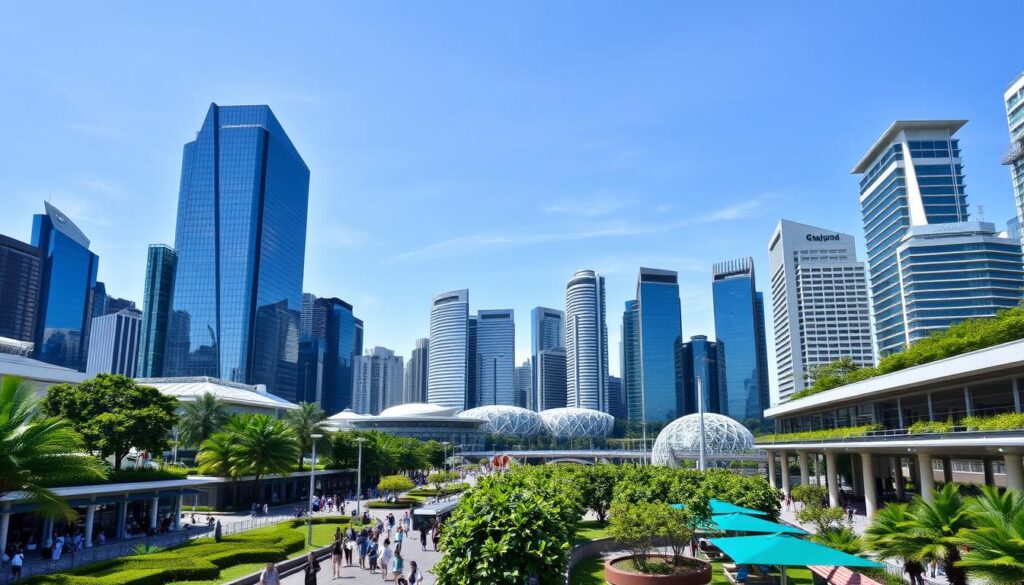
Singapore’s commercial property market is still attracting global investors, even with cooling measures in place. The warehouse segment in the industrial sector has seen significant growth. The JTC All Industrial price and rental indices have hit their highest levels since 2015-2016.
For eleven straight quarters, these indices have kept rising. This shows Singapore’s industrial real estate is both resilient and attractive.
Strong demand and limited supply have pushed prime logistics assets in Singapore to near full capacity. Only a few new facilities are expected by the end of 2025. This scarcity has sparked investor interest, as they aim to benefit from Singapore’s role as a regional logistics hub.

The Global Investor Programme (GIP) by the Singapore government has also increased the city-state’s appeal. It attracts ultra-high-net-worth individuals who want to become Permanent Residents through real estate investments.
Key Takeaways
- Singapore’s commercial property market, especially the industrial sector, has been a consistent performer, with the JTC All Industrial price and rental indices reaching record highs.
- The limited supply and high demand for prime logistics assets have made Singapore an attractive destination for foreign investors seeking to capitalize on the country’s strategic position as a regional logistics hub.
- The Global Investor Programme (GIP) has further bolstered Singapore’s appeal, attracting ultra-high-net-worth individuals to invest in the country’s real estate market.
- Strata industrial volumes have remained robust since the depths of the pandemic, indicating the continued strength of the industrial property market.
- The stability and growth of Singapore’s commercial property market have made it a preferred destination for cross-border industrial investments in the Southeast Asian region.
Overview of Singapore’s Real Estate Market
Singapore’s commercial real estate market has shown great strength, even in tough global times. The industrial sector stands out, with rents up 14.5% since Q3 2020. Warehouse rents have jumped 15.9% in the same time.
The private warehouse space is very tight, with vacancy rates lower than before the pandemic. Prime logistics spots are highly sought after, and new supply is limited until 2025.
In retail, transactions soared by 31.10% in Q1 2022. Shophouse deals grew by 28.23%. Orchard Road remains a top shopping spot, ranking 12th globally.
The fine dining sector saw a 2.8% spending increase in 2024, down from 3.5% in 2023. This shows its ability to bounce back.
The Singapore Real Estate Market is set to reach USD 46.58 billion in 2024. It’s expected to grow to USD 64.04 billion by 2029, with a 6.57% CAGR. The market is competitive, with big players like UOL Group Limited, CapitaLand, and City Developments Limited leading the way.
Factors Driving Foreign Investment
Singapore’s stable economy and pro-business environment attract foreign investors. The country’s currency is like the Swiss franc, seen as a safe investment. It also offers tax benefits, with no income tax, capital gains tax, estate tax, or gift tax for foreigners.
Family offices in Asia-Pacific have boosted investment in Singapore’s commercial real estate. Since 2020, 229 family offices have registered here. They are drawn by Singapore’s status as a global financial hub and its diverse commercial properties.
American citizens face the same ABSD rates as Singaporeans. This makes Singapore a great choice for US investors looking to grow their commercial real estate. The limited land in Singapore drives up property values, attracting more foreign investment.
Sustainable buildings with energy-efficient designs are popular in Singapore’s market. This fits with the government’s green building goals. Foreign investors, especially those focused on the environment, see Singapore as a key place for their investments.
Strategic Location of Singapore
Singapore’s location in Southeast Asia attracts many foreign investors. It’s known for stability, connectivity, and top-notch infrastructure. The government also supports businesses, making it a top choice for setting up regional hubs.
Being a gateway to Asia, Singapore’s industrial and logistics sectors are booming. In 2023, its exports per capita hit $82,900. Over 40 years, total exports have grown by 6.8% each year, showing Singapore’s importance in global trade.
Industrial property deals in Singapore have doubled in the last decade. Even with a 7.7% drop in leasing in Q1 2024, the electronics sector is doing well. With the global semiconductor market expected to grow by 13% in 2024, Singapore is ready to take advantage of this trend.
Singapore’s excellent transport and logistics systems make it easy to reach global markets. The IMF predicts global trade will grow by 3% in 2024 and 3.3% in 2025. This makes Singapore an even more attractive place for investors and developers.
Popular Types of Commercial Properties
Singapore’s commercial real estate market is diverse and attractive to foreign investors. Office spaces in the city’s Central Business Districts are highly sought after. They are known for their prime locations and top-notch infrastructure.
Retail properties, like shopping malls and restaurants, are also in demand. They meet the growing need for consumer goods and services. Shophouses are another popular choice, offering a mix of retail and residential space.
Industrial and logistics facilities, especially warehouses and high-specification factories, are in high demand. This is due to the rise of e-commerce and the need for diverse supply chains. The data center sector is also booming, with four operators getting 80MW of new capacity after a three-year moratorium.
Investors can look into various commercial property types. Each has its own characteristics and potential for Property Valuation and returns. These include office buildings, retail spaces, industrial properties, multifamily residential, hotels, and specialized facilities. Singapore’s commercial real estate offers many opportunities for foreign investors looking to make the most of the thriving Commercial Property market.
Government Initiatives Supporting Investment
The Singapore government has launched several initiatives to boost foreign investment in commercial property. The Urban Redevelopment Authority is working on new business districts and updating old ones. This makes Singapore’s real estate market more appealing to investors.
To attract foreign investors, the government offers a 10% property tax on commercial buildings. The Global Investor Programme (GIP) also gives Singapore Permanent Resident status to eligible investors. This move encourages more foreign investment in the real estate sector.
The Digital Integration Incentive (DII) aims to boost the market with software for easy tax filing and e-invoicing. The LEAD Connect Grant and LEAD Transact Grant offer funding for large companies adopting new finance and e-commerce solutions.
The Maritime Innovation and Technology Fund (MINT), Productivity Solutions Grant (PSG), and Public Sector Construction Productivity Fund (PSCPF) are part of the government’s efforts. They support different areas of the real estate industry, creating a favorable environment for foreign investment.
Investment Risks Associated with Commercial Property
Investors in the Singapore commercial property market face several risks. The market’s ups and downs are influenced by global economic changes and stricter lending rules. These factors can greatly affect property values. Also, the 30% Additional Buyer’s Stamp Duty for foreign buyers adds complexity.
The market is expected to see a lot of new industrial space from 2024 to 2026. This could slow down rental and price increases. For those in Property Management and Commercial Leasing, this change will be a challenge.
Conservative investors look at tenant credit and lease length to lower risks. They prefer properties with stable tenants and strong finances. Yet, risks like tenant bankruptcy and unpaid rent can still affect profits.
Also, labor, materials, and service costs can impact a property’s NOI and value. Rising Consumer Price Index can lead to higher costs for repairs, taxes, and insurance. These costs can hurt property economics.
To succeed in Singapore’s commercial property market, investors need to understand these risks. By staying informed and flexible, they can manage these challenges. This way, they can achieve long-term, stable returns on their investments.
The Role of Technology in Real Estate
Technology is key in Singapore’s commercial real estate. Smart buildings now save energy and work better. This makes old buildings meet new needs.
Industry 4.0 has made industrial places more efficient. This has led to the use of new tech.
PropTech has changed how we invest in real estate. It uses data and smart property management. Research shows 61% of firms use old tech, but half are updating.
The PropTech market grew to USD $25,145.1 million in 2021. It’s expected to grow 15.8% yearly until 2030. This growth comes from IoT, machine learning, and virtual reality.
Now, a property’s value depends on its tech. This tech helps tenants and customers. It also lets professionals work from anywhere.
Artificial intelligence helps a lot. It’s great for building analysis and managing facilities. It also helps brokers find leads.
The rise of e-commerce has boosted demand for tech in warehouses. Cybersecurity and social media are also key. They protect data and help market properties.
In summary, technology is changing Singapore’s commercial real estate. It’s important for keeping up with tenant needs and staying competitive.
Case Studies of Successful Foreign Investments
Singapore’s commercial property market attracts smart foreign investors looking for good returns. Many examples show why Singapore real estate is so appealing.
In the early 1990s, Steve Kay bought the Birmingham Custard Factory for £1.5 million. Now, it’s worth over £15 million. This shows how Commercial Property can grow a lot over time.
The Old Granada Studios in Manchester was bought by Allied London group for £5 million. It’s now worth over £25 million after development.
Roger Black bought properties in London’s Shoreditch for £3 million. Now, they’re worth over £30 million. In Glasgow, Tom Hunter’s £10 million investment in the Merchant City area is now worth £50 million.
These stories show the benefits of investing in Singapore’s Commercial Property. Strong economy, strategic location, and government support make it a great place for Real Estate Investments.
Financing Options for Foreign Investors
Singapore’s commercial real estate market is full of Investment Opportunities for foreign investors. They can use different financing options to fund their commercial leasing ventures. Local banks in Singapore offer competitive loan packages for commercial property purchases.
The Singaporean government also supports foreign investors with grants and schemes like the Global Investor Programme (GIP). These initiatives make Commercial Leasing in Singapore even more appealing. Foreign investors can get extra financial help to achieve their investment goals.
The stability of the Singapore dollar and the country’s strong financial sector attract foreign investors. There are many lending solutions available. Foreign investors can find the best option for their commercial property investment strategies in Singapore.
Foreign investors have many financing choices in Singapore. From bank loans to fintech lenders and licensed moneylenders, there’s a wide range. By looking at these options carefully, foreign investors can make the most of Singapore’s Commercial Leasing landscape. They can reach their investment goals.
Future Trends in Singapore’s Commercial Real Estate
Singapore’s commercial real estate market is set for big changes. Sustainability and energy-efficient buildings are key, thanks to the government’s green push. After the pandemic, there’s a growing need for flexible office spaces and hybrid work models.
The industrial sector, like warehouses and data centers, will keep growing. Singapore is home to 60% of Asia Pacific’s data centers, making it a key hub. Developers are building top-notch warehouses and distribution centers for both global and local businesses.
Joint ventures and strategic partnerships are becoming more common. They help share resources and risks in Real Estate Development and Property Management. Investing in industrial and logistics-focused Real Estate Investment Trusts (REITs) is also popular, offering investors a chance to tap into these sectors’ growth.
Sustainability will be a big focus in the industrial and logistics sectors. There will be a push for green building, energy efficiency, and reducing waste. Companies are investing in automation and energy-saving systems to stay ahead and meet market demands.
Community and Cultural Considerations
Foreign investors in Singapore’s commercial real estate market must think about the local community and culture. Building strong ties with government agencies, industry partners, and other stakeholders is key for long-term success. This is true for both Commercial Property and Real Estate Investments.
Singapore’s business culture emphasizes efficiency, transparency, and professionalism. Understanding these values helps foreign investors move through the market more smoothly. Adapting to local customs, like respecting hierarchy and maintaining face, builds trust and collaboration with Singaporeans.
Also, getting involved in the local community opens up new chances and improves the investment experience. Supporting cultural events and contributing to the neighborhood’s social fabric makes a good impression. It helps foreign investors blend in better.
By valuing community and cultural aspects, foreign investors in Singapore’s Commercial Property and Real Estate Investments can form lasting partnerships. They can navigate the market more easily and reach the full potential of their investments.
Conclusion: The Enduring Appeal of Singapore Commercial Property
Singapore’s commercial property market remains attractive to foreign investors, even with new cooling measures in September 2022. The country’s stable economy, strategic location, and business-friendly environment attract many investors. The removal of Additional Buyer’s Stamp Duty (ABSD) for commercial properties makes it even more appealing.
Singapore offers a variety of commercial properties, like modern offices, industrial spaces, retail spots, and hotels. Foreign investors find these options appealing. The country’s policies allow foreign ownership of commercial properties, with clear rules for each type.
Investing in Singapore’s commercial property market requires careful planning and knowledge. Properties near transport, schools, or malls often see better growth. Areas like Jurong, Punggol, and Sengkang are also gaining value due to new infrastructure. With higher rental yields than homes, Singapore’s commercial real estate is a top choice for global investors.
